
Section:
KEYWORDS
- Neurotechnology
- Neural interfaces
- Neural activity monitoring
- Neurostimulation
- Magnetic biosensing
- Spintronic sensors
- Implantable medical devices.
Description
A novel medical device combining highly sensitive magnetic sensing and electrical stimulation for monitoring and modulating the activity of electrically excitable cells. The technology enables the detection of ultra-low magnetic signals generated by neural activity and can integrate recording and stimulation functions within a compact, biocompatible and potentially implantable device.
The Technology
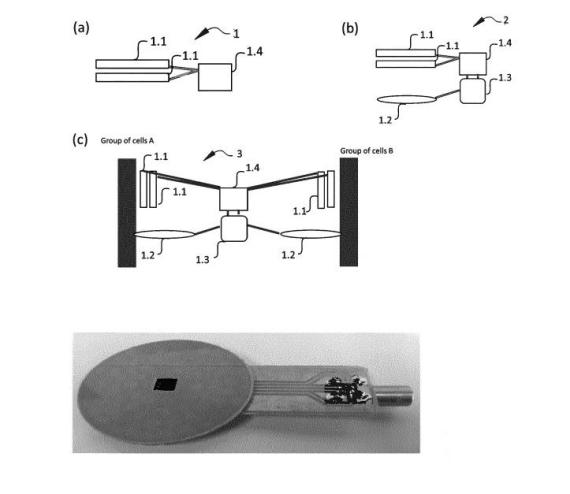
The technology is based on highly sensitive spintronic magnetic sensors, particularly magnetoresistive sensors, capable of detecting the very weak magnetic fields generated by electrically excitable cells such as neurons.
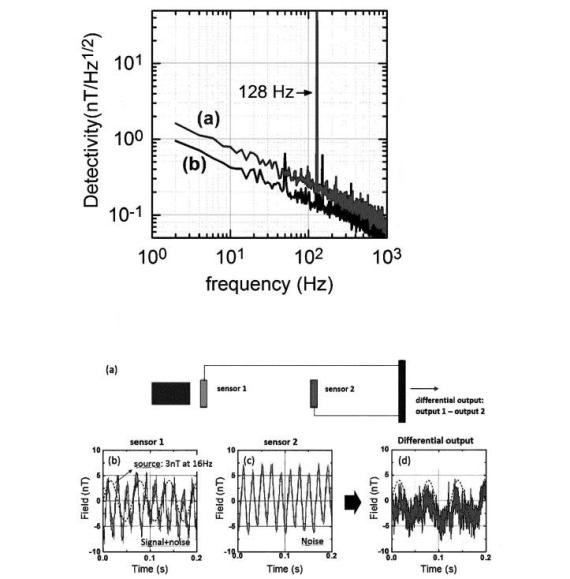
The sensors can be arranged in a differential configuration, with two probes positioned at different distances from the biological source. This configuration allows external magnetic noise to be reduced and improves the detection of the magnetic signal of interest.
The sensing surface can be coated with a biocompatible micropatterned polymeric layer, designed to improve interaction with neural cells. The system can additionally incorporate flexible nanostructured electrodes for electrical stimulation.
By integrating sensing, signal processing and electrical stimulation, the technology enables the development of devices capable of monitoring neural activity and delivering electrical stimulation in response, including configurations designed to operate bidirectionally between different groups of electrically excitable cells
Experimental Validation
The technology has been experimentally validated using neural cultures and organotypic spinal cord slices. Magnetic sensors detected neural activity in real time, with recordings performed alongside calcium imaging. The patent reports magnetic signals in the order of tenths of nT and confirms their neuronal origin through pharmacological inhibition.
Biocompatibility and electrical stimulation were also investigated using nanostructured metallic electrodes and neural cultures.
Potential Applications
- Neural activity monitoring
- Neural stimulation and neuromodulation
- Bidirectional neural interfaces
- Implantable neurostimulation devices
- Interfaces for restoring or modulating signal transmission between electrically excitable cells
- Research platforms for in vitro and ex vivo neural monitoring and stimulation
Advantages
- High sensitivity: magnetoresistive sensors can detect ultra-low magnetic fields associated with neural activity. Il brevetto indica sensori con detectivity inferiore a 10 nT/√Hz sotto 100 Hz, con configurazioni preferite inferiori a 1 nT/√Hz.
- Noise reduction: differential sensor configuration reduces unwanted external magnetic signals, improving extraction of the biological signal of interest.
- Biocompatible neural interface: micropatterned polymer coatings support interaction with neuronal tissue and, negli esperimenti descritti, favoriscono l'allineamento delle fibre neuronali.
- Combined monitoring and stimulation: the same technological platform can integrate magnetic monitoring with electrical stimulation.
- Bidirectional operation: one of the proposed device configurations is designed to transmit signals between two groups of electrically excitable cells in both directions.
- Potential implantability: the patent explicitly provides for biocompatible and optionally implantable probes and medical devices.
- Compact, non-cooled sensing: embodiments include micron-sized spintronic sensors that do not require additional refrigeration and can operate between 20 °C and 45 °C.
Patent co-owners: Fundación IMDEA Nanociencia; Centre National de la Recherche Scientifique (CNRS); Scuola Internazionale Superiore di Studi Avanzati (SISSA); Consejo Superior de Investigaciones Científicas (CSIC); Servicio de Salud de Castilla-La Mancha (SESCAM).
Inventors:
- María Teresa González Pérez
- Julio E. Camarero de Diego
- Lucas E. Pérez García
- María Isabel Rodríguez Fernández
- Rodolfo E. Miranda Soriano
- Paolo Perna
- Isidoro E. Martínez Ramírez
- Rubén E. Guerrero Sánchez
- Beatriz Loreto Rodilla González
- Ana E. Arché Núñez
- Arturo E. Vera García
- Luiz Guilherme Enger
- Stéphane Flament
- Bruno Guillet
- Marc Ah-Liong Lam Chok Sing
- Laurence Liliane Mechin
- Olivier Henri Marc Rousseau
- Laura Ballerini (SISSA)
- Denis Scaini (SISSA)
- Ivo Calaresu (SISSA)
- María Concepción Serrano López-Terradas
- Ana Domínguez Bajo
- Elisa López Dolado
- Francisco Ankor González Mayorga
- Sylvain Lebargy
European patent application: EP 3 939 497 A1


